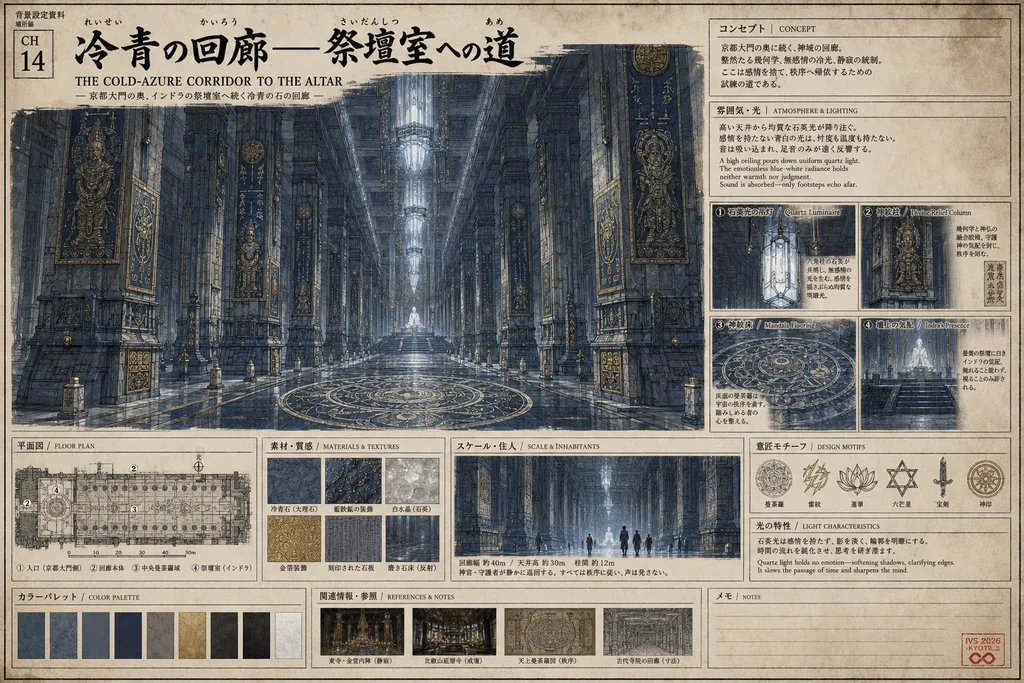
冷青の祭壇室の対峙——インドラ降臨
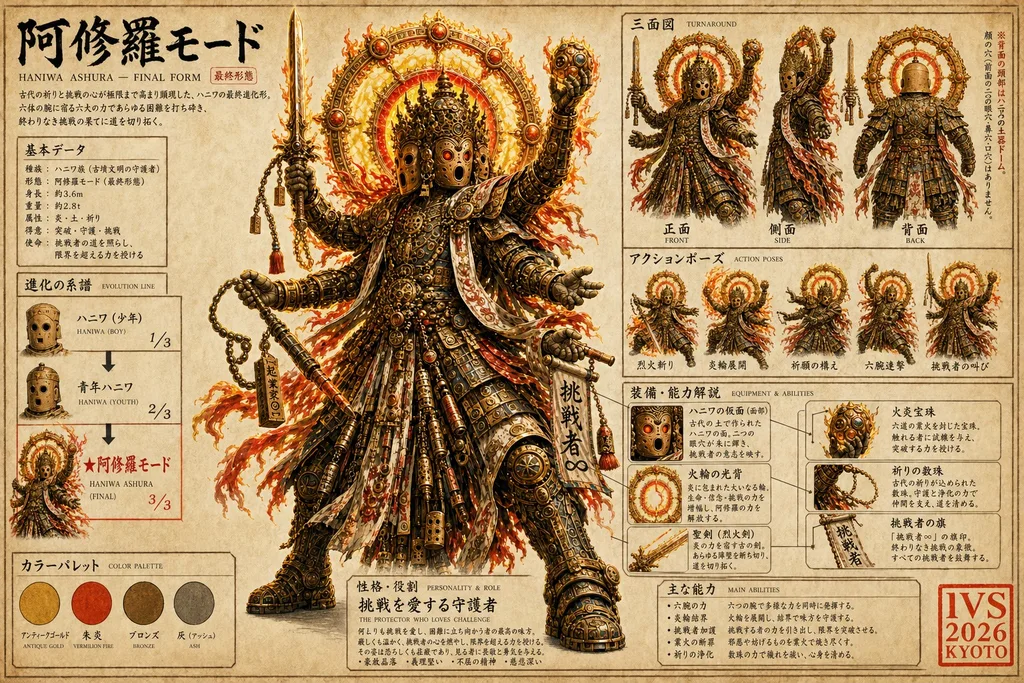
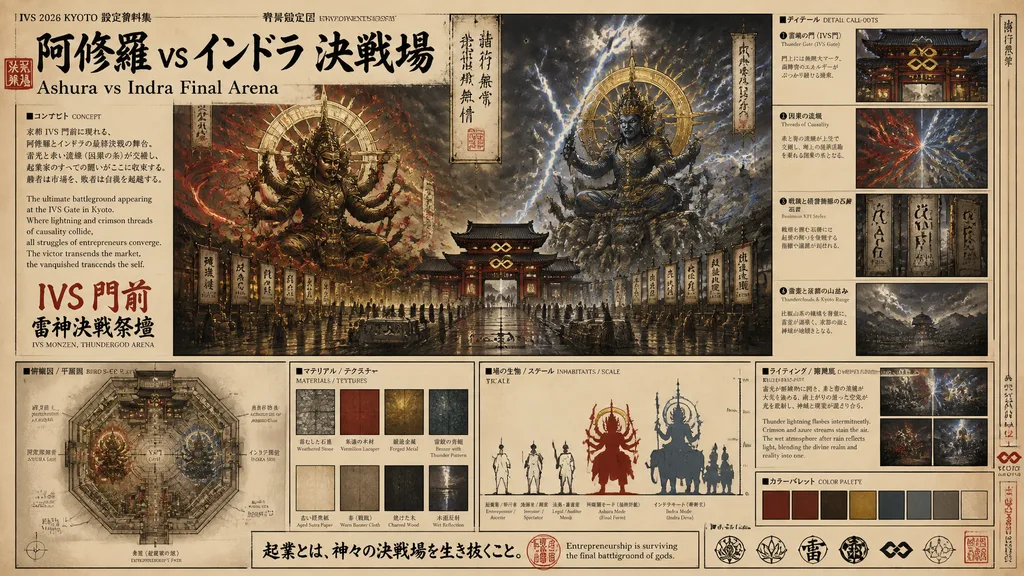
11 cuts · 0:45山門の向こうは冷青の祭壇室。幾何学的な石柱が整然と並ぶ、感情のない均質光の神域に、自らの意志で覚醒した六腕の阿修羅(ハニワ)が踏み入る。奥の壇上には、ドグーがインドラへと変容して待つ——遮光器の同心円ゴーグルが幾何秩序の光を放ち、白金に輝き、金剛杵を携える。創造(混沌)の阿修羅と支配(秩序)のインドラが、初めて正対する。「君は混沌から未来をつくる。僕は秩序で未来を支配する。」とインドラが冷淡に宣言し、阿修羅は金剛力士を裏で動かしていたのがインドラだったと気づく。インドラは言葉でなく頷きで肯定し、「話す」ことの代替として宿命の戦いが始まる。互いの世界観が衝突する地図が、床の光の境界線として一枚で完成する。最後に阿修羅とインドラが祭壇室の天蓋を突き破って雲上へ駆け上がり、sc02 の空中戦へ雪崩れ込む。
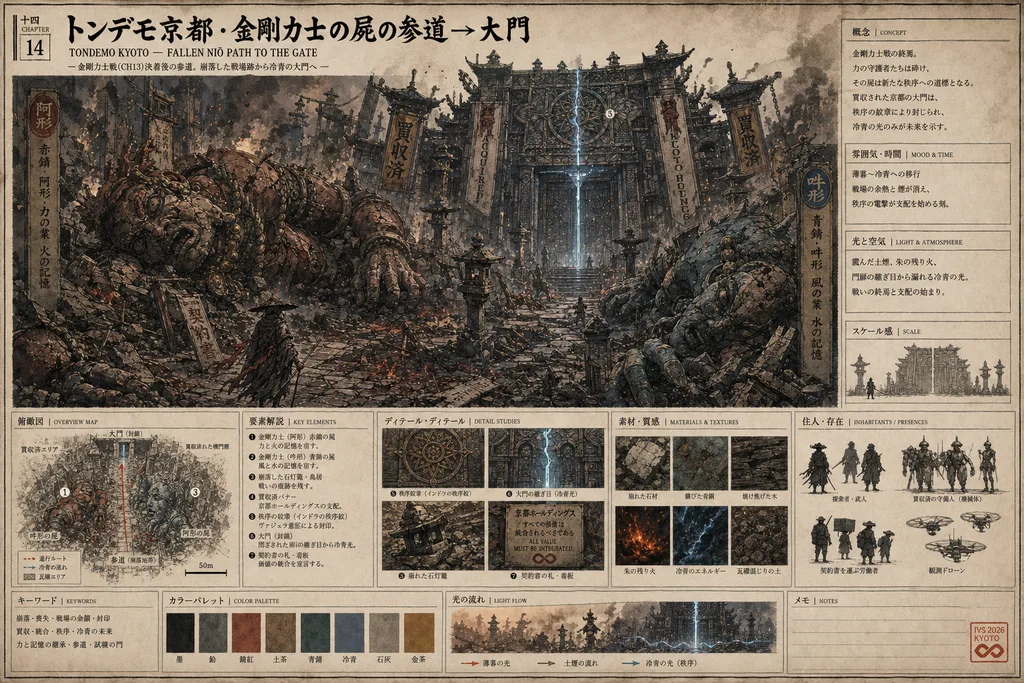
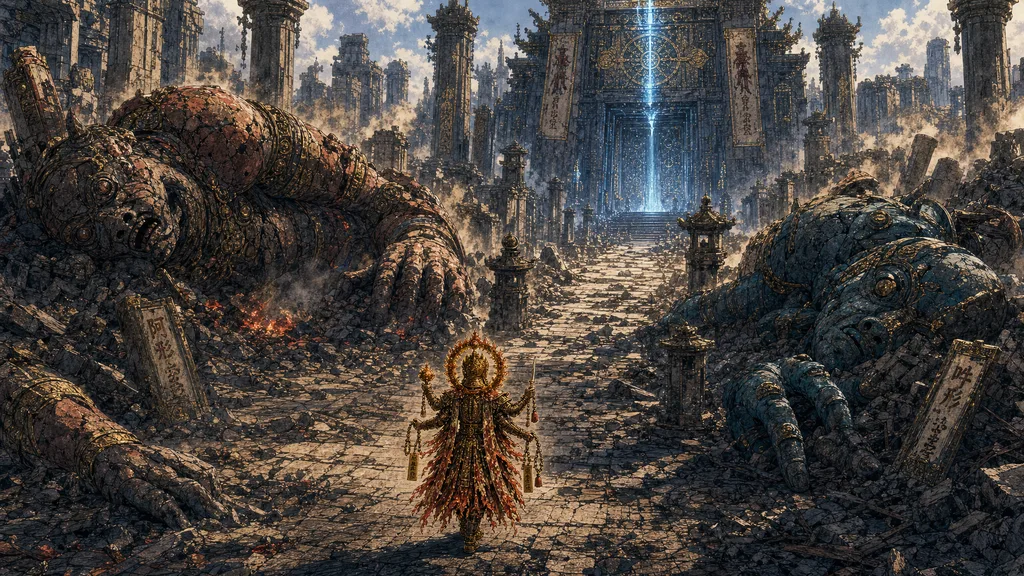
★【天候=明るい昼】CH13戦闘(昼)の直後として戦場跡は明るい日中の光に照らされる。薄暮/夕暮れ/全体が暗いトーンにはしない。崩落参道と金剛力士の屍は明るい昼光で、遥か奥の大門のみ冷青光を放つ。 金剛力士戦の決着直後の戦場跡を見渡す超ロング ELS(CH13→CH14 のブリッジ・引きの圧倒的スケール)。明るい昼の光に満ちた崩落した京都の参道に、倒した金剛力士二体(阿形=赤錆/吽形=青錆)の巨大な石の屍が砕けて横たわる——割れた石肌、剥がれかけた金箔、まだ燻る朱の残り火と立ち上る土煙。その屍の谷間を縫って、六臂の阿修羅(ハニワ)が一人、遥か奥にそびえる京都の大門(買収された冷青の宮殿入口)へ向かって歩み去る後ろ姿(画面下手前に小さく)。勝利の代償と次の試練を一枚で読ませる。★スケール基準: 屍の石の巨躯 vs 人間スケールの阿修羅 vs 遠景の大門の威容、を三層で対比し、進む先(大門)に冷青光が滲む。★阿修羅=公式KV単一面(金鍍金の装飾ハニワ面)・六臂・剣/刀なし・背面規律(後頭部の素焼きドームは無孔・前面の顔/眼穴を背面に複製しない)。★金剛力士は阿形/吽形の二体のみ・砕けた屍として(動かない)。墨ベタ線画+crosshatch、VIVID full-color painted-cel(明るい昼の光・前章CH13戦闘の昼の余韻・空は明るい/暗い夕暮れにしない・朱を一点、遥か奥の大門だけ冷青光)。★象なし。
Kling 3.0 Omni (Multi-Shot) を ON にして、first frame に このカット(c14-s1-1)・last frame に 次カット(c14-s1-2) を Bind → 下の 3 枠を Shot 1〜3 に各々ペースト。HARD CUT で繋ぐ ~4s。
Sanctuary doorway holds still; cold blue-white light fills the geometric hall, Indra silhouetted on the far altar.
Camera advances calmly down the stone columns, the silhouette growing while the chill stays even. STRONG MOTION: at the moment of contact a ring shockwave detonates from the impact point, blasting the cloud-sea, smoke and debris violently OUTWARD in all directions; dust rings expand, banners and dust streak away from the blast. Big, decisive displacement — never a small jiggle.
Final settle near the threshold of the altar; the room's symmetry resolves around Indra.
山門の向こうに広がる冷青の祭壇室。均質な青白光に満ちた幾何学的空間の入口から、奥の壇上に立つインドラのシルエットへと冷静に踏み込む。
ドリーインで距離を詰めることで、観客の身体感覚を阿修羅の歩みに重ね、秩序の冷たさを建築として体験させる。
空間そのものをキャラクターとして提示し、暖かさを欠いた光で「秩序の冷たさ」を冒頭に刻印する。
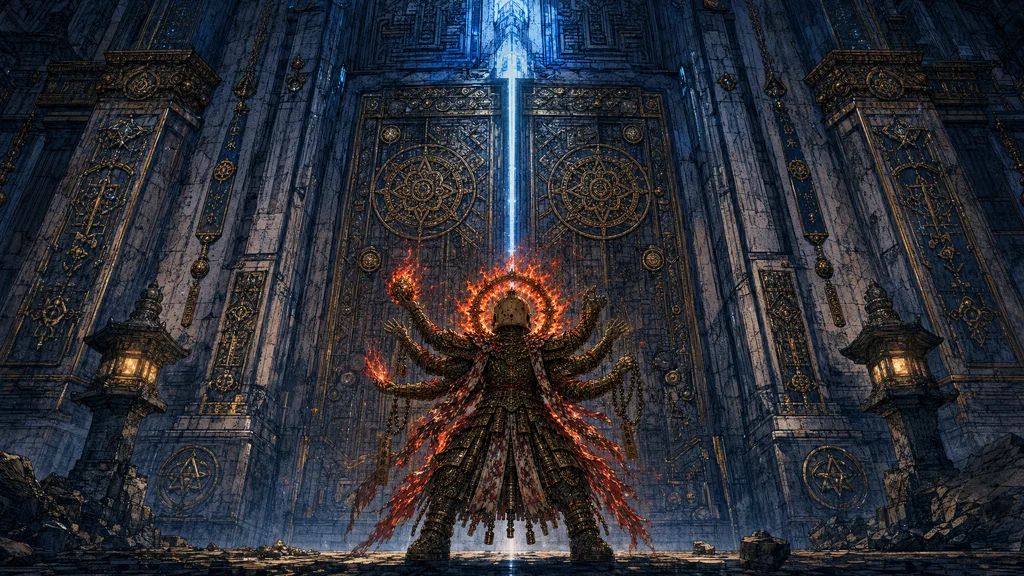
京都の巨大な大門(買収された冷青の宮殿入口)の閉ざされた石扉の前に、阿修羅が【全身】で立つ仰角ワイド WS。門は人間スケールの阿修羅の数倍の威容で、幾何学的な異国情緒の彫刻(インドラの秩序紋・ヴァジュラ意匠)が冷たく刻まれる。閉じた重い石扉の継ぎ目から冷青光(電撃ブルー+白金)が一筋漏れ、内側の異質な秩序の領域を予兆する。阿修羅の朱の火がその冷たい門の前で唯一の暖色として揺れ、暖(朱)が冷(青)の領域へ挑む構図。門の上部・両脇に金と藍の装飾、足元に砕けた石灯籠。★門の奥(インドラ)はまだ見せない。★阿修羅=公式KV単一面・六臂・剣/刀なし・背面規律。墨ベタ線画+crosshatch、VIVID full-color painted-cel(冷青+金+藍に朱を一点)。★象なし。
Kling 3.0 Omni (Multi-Shot) を ON にして、first frame に このカット(c14-s1-2)・last frame に 次カット(c14-s1-3) を Bind → 下の 2 枠を Shot 1〜2 に各々ペースト。HARD CUT で繋ぐ ~4s。
Symmetrical wide: Ashura vermilion left, Indra platinum right, central light seam glowing on the floor.
Hold the standoff; subtle particles drift, six arms flex once, vajra hums; the boundary line stays razor sharp. STRONG MOTION: at the moment of contact a ring shockwave detonates from the impact point, blasting the cloud-sea, smoke and debris violently OUTWARD in all directions; dust rings expand, banners and dust streak away from the blast. Big, decisive displacement — never a small jiggle.
両者が対峙する全景。阿修羅の朱と六腕が左、インドラの白金と雷光が右。中央に光の境界線が走り、冷と暖、混沌と秩序の地図が一枚で完成する。
FIX のワイドショットで左右対称を維持し、二つの世界観が地図のように対立する図解として提示する。
フレームを「世界観の衝突」の図そのものに変え、後続の対話と戦闘の前提となる二項対立を視覚化する。
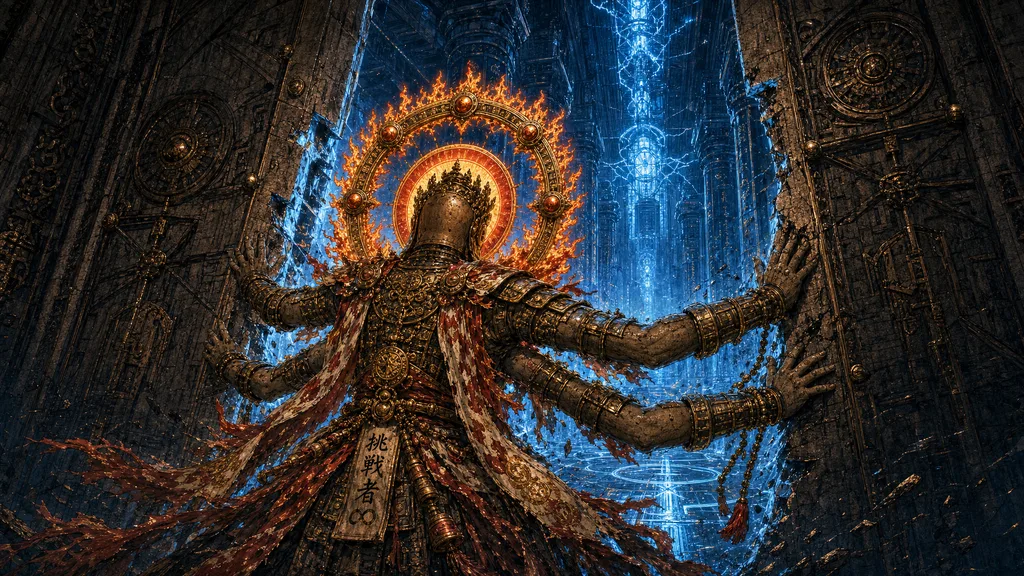
阿修羅が六臂で巨大な石扉を押し開く瞬間の MS(暖が冷へ踏み込む転換点)。三対=六本の腕が扉に手をかけ、軋みとともに重い石扉が左右へ割れて開き、その隙間から冷青光(電撃ブルー+白金)が奔流のように溢れ出して阿修羅の朱のシルエットを背後から飲み込む。扉の質量感、粗い石の継ぎ目、開口の奥に幾何学石柱の冷青回廊がわずかに覗く。暖(朱・阿修羅)と冷(青・秩序)が扉の境界で正面衝突する。★阿修羅=公式KV単一面・六臂・剣/刀なし・後頭部無孔(背面規律)。墨ベタ線画+crosshatch、VIVID full-color painted-cel(朱のシルエット vs 溢れる冷青光)。★象なし。
Kling 3.0 Omni (Multi-Shot) を ON にして、first frame に このカット(c14-s1-3)・last frame に 次カット(c14-s1-4) を Bind → 下の 3 枠を Shot 1〜3 に各々ペースト。HARD CUT で繋ぐ ~5s。
Indra's concentric-circle eyes fill the frame, rotating with hard geometric angular velocity.
He speaks; jaw barely moves, eye rotation tightens by one notch as the declaration lands. STRONG MOTION: at the moment of contact a ring shockwave detonates from the impact point, blasting the cloud-sea, smoke and debris violently OUTWARD in all directions; dust rings expand, banners and dust streak away from the blast. Big, decisive displacement — never a small jiggle.
A breath of stillness after the line; the cold light flares minutely around the iris ring.
インドラの同心円目のクロースアップ。かつて柔らかく回転していた目が、いまは硬い幾何学的角速度で回り、「創造」対「支配」の対立を冷淡に宣言する。
FIX で動かさず、瞳の機械的回転だけを観客に凝視させることで、台詞の静かさを最大の重みに変える。
静かな声量で最も重い言葉を運び、秩序が支配の論理に滑り落ちた瞬間を瞳の硬さで体現する。
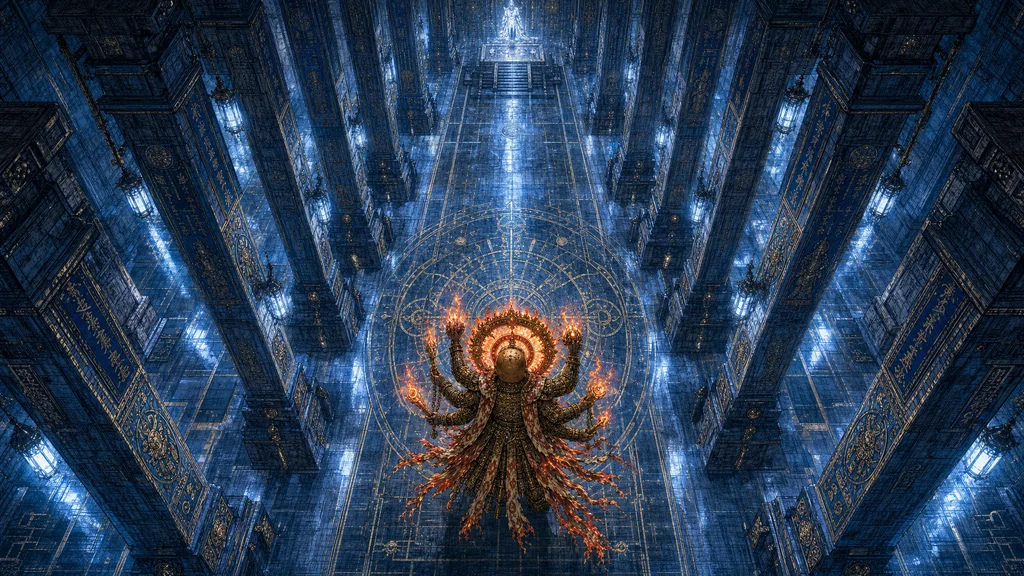
★【真上からの俯瞰=overhead / TOP-DOWN】開いた扉の奥、祭壇室へ続く冷青の石の回廊を【真上から見下ろす】俯瞰 TRACK-IN(祭壇室への没入導入)——カメラは天井近くの真上から床を見下ろし、回廊の幾何学が地図のように読める。整然と並ぶ幾何学的石柱が左右対称の列をなして奥(画面上方)へ一点透視で収束し、床には大きな曼荼羅状の神紋が円として見下ろされ、高い天井から均質な青白の石英光(感情のない無感情光)が降る。回廊の中央を、阿修羅が奥(画面上方)の祭壇室へ向かって進む——真上視点なので見えるのは【頭頂の素焼きドーム上面(無孔の滑らかな曲面)】と、放射状に広がる六腕、火炎冠と火炎輪光背の朱の輝き(★真俯瞰のため前面の顔/眼穴は見えない・上面/後頭部に顔を描かない)。その朱の火だけが唯一の暖色として、冷たい青白の回廊を奥へ進む小さな姿として読める。遥か奥(画面上端)の祭壇室の壇上に、白く小さな光(インドラの気配・まだ正体を見せない・遠く小さく)が滲む。俯瞰が回廊の左右対称性と奥への距離・没入感を強調する。★阿修羅=公式KV単一面・六臂・剣/刀なし。墨ベタ線画+crosshatch、VIVID full-color painted-cel(冷青+金+藍に朱を一点)。★象なし。
Kling 3.0 Omni (Multi-Shot) を ON にして、first frame に このカット(c14-s1-4)・last frame に 次カット(c14-s1-5) を Bind → 下の 2 枠を Shot 1〜2 に各々ペースト。HARD CUT で繋ぐ ~4s。
Six vermilion eye-points hold steady against deep clay skin; no tremor, only a slow inner glow.
Light from Indra's side grazes the eye edges; vermilion pulses once, calmly, then settles. STRONG MOTION: at the moment of contact a ring shockwave detonates from the impact point, blasting the cloud-sea, smoke and debris violently OUTWARD in all directions; dust rings expand, banners and dust streak away from the blast. Big, decisive displacement — never a small jiggle.
阿修羅の六点の目の超クロースアップ。インドラの台詞を聞いた後の静止——朱が揺れず安定し、穏やかな確信が最も力強い反応として現れる。
ECU の極端な近さで「揺れのなさ」を可視化し、動揺の欠如そのものをドラマに変換する。
動かないことが反応である、という逆説を提示し、阿修羅の覚悟が言葉以前に完成していることを示す。
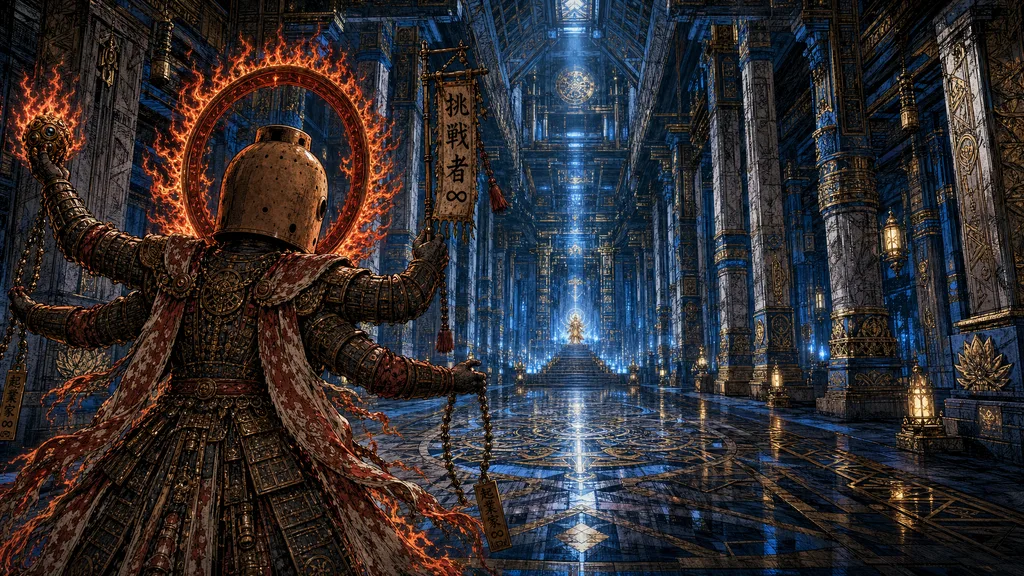
阿修羅が冷青の回廊を抜けて【祭壇室の中心=壇上の前へ踏み入る】導入 LS(章の色基準・後方からの追従)。手前に阿修羅の後ろ姿(六腕・火炎冠・火炎輪光背・挑戦者∞幟・★背面=後頭部の素焼きドームは無孔で前面の顔/眼穴を背面に複製しない)、その肩越しに、冷青の石柱の回廊を抜けると——眼前に【冷青と金で彩られた異国情緒の壮麗な祭壇宮殿】が一気に開ける。精緻に彫り込まれた石柱が遠近で奥へ列をなし、床には大きな曼荼羅状の神紋、高い天井から均質な青白の石英光が降り、金の装飾と藍のタイルが冷たく輝く。遥か奥の壇上に、白く小さな光(インドラの気配・まだ正体を見せない・遠く小さく)。阿修羅の朱の火だけが唯一の暖色として、冷たい宮殿の奥へ踏み込んでいく没入感。カメラは阿修羅の背を追って宮殿の奥へゆっくり進む。屋外の空/都市/東京タワーは一切出さない(宮殿に閉じ込める)。★阿修羅=公式KV単一面(金鍍金の装飾ハニワ面)・六臂・剣/刀なし・背面規律。墨ベタ線画+crosshatch、VIVID full-color painted-cel(冷青+金+藍に朱を一点)。★象なし。
Kling 3.0 Omni (Multi-Shot) を ON にして、first frame に このカット(c14-s1-5)・last frame に 次カット(c14-s1-6) を Bind → 下の 3 枠を Shot 1〜3 に各々ペースト。HARD CUT で繋ぐ ~5s。
Over Ashura's foreground arm: Indra centered, vajra resting; pause before the line.
Ashura's question lands quietly; foreground arm fingers flex once as recognition completes. STRONG MOTION: at the moment of contact a ring shockwave detonates from the impact point, blasting the cloud-sea, smoke and debris violently OUTWARD in all directions; dust rings expand, banners and dust streak away from the blast. Big, decisive displacement — never a small jiggle.
Beat of silence; Indra does not yet move, but the air around the vajra brightens.
阿修羅の六腕の一本が前景OS。インドラが中央に立つ。語尾が断定に近い疑問——気づきの瞬間を「……」の間で先行させ、認識が追いつく速度の遅さを描く。
FIX の OTS で観客を阿修羅の肩越しに置き、彼の認識遅延を観客にも同じ速度で体験させる。
言葉が出る前に間を支配させ、「知ってしまった」事実の重さを沈黙で運ぶ。
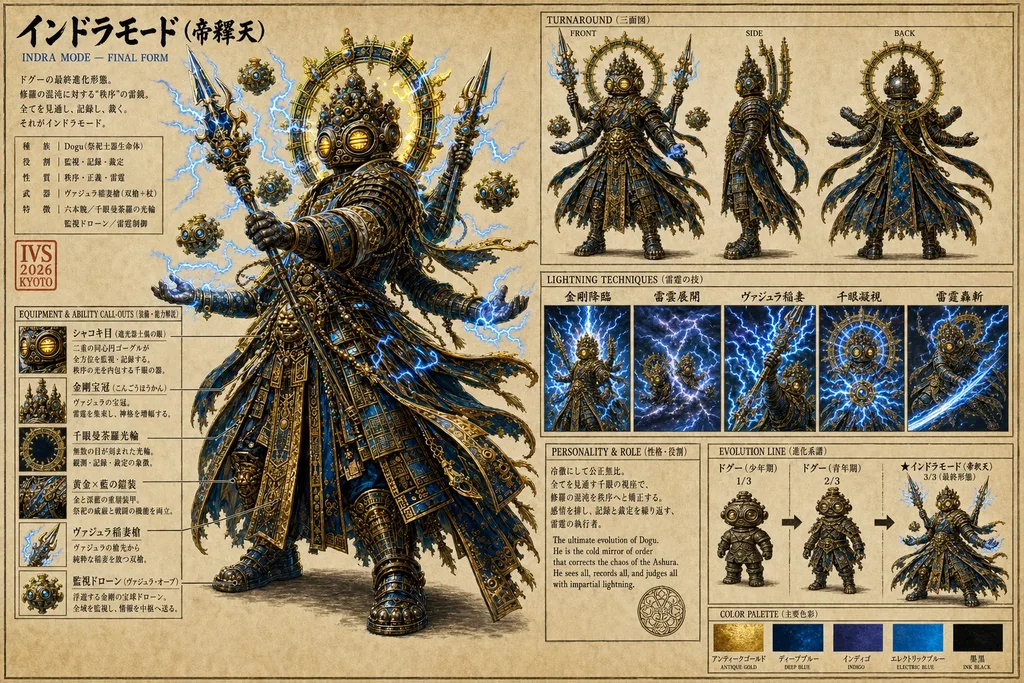
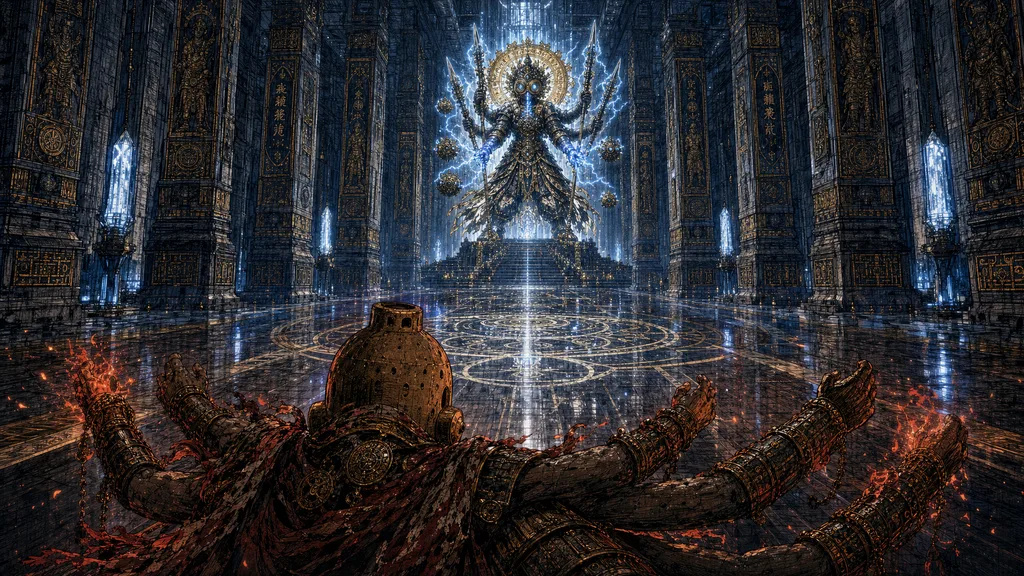
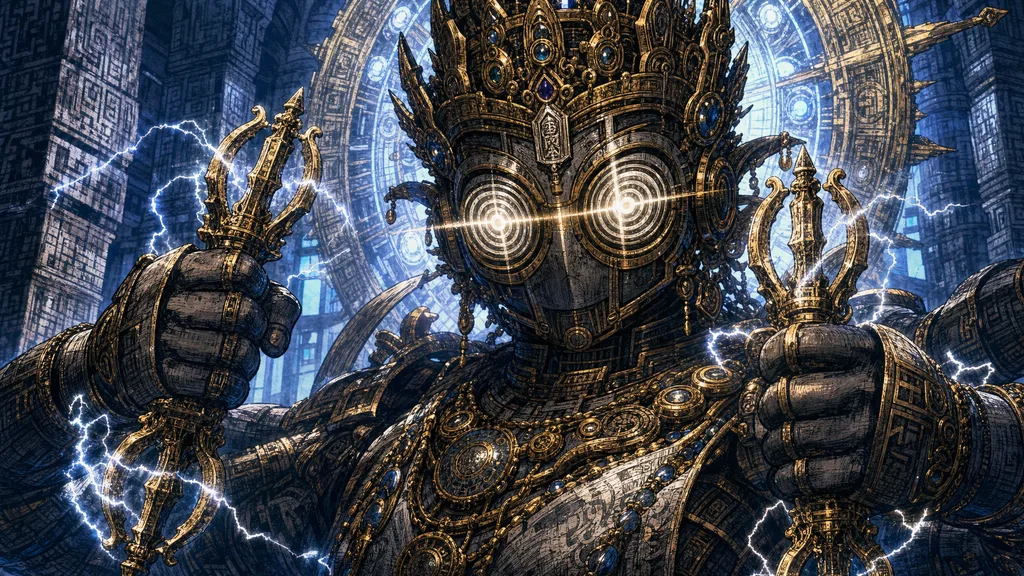
★【真正面・遠方からのドグー=インドラ最終形態】壇上のインドラを【真正面・左右対称・遠方】から捉える LS——阿修羅の視点に立つ、最終形態の初めての明確な視認。冷青の祭壇室の奥、高い壇上に、ドグーが変容した【六臂の電撃神インドラ(公式KV準拠)】が【全身】で屹立する: 中央2手に大ヴァジュラ杖・上左右2手にヴァジュラ稲妻槍・下左右2手から強烈な青い電撃、遮光器の同心円ゴーグル【2眼のみ】(第三/額の目なし)が幾何秩序のオーダー光を放射し、金剛宝冠(ヴァジュラ突起と結晶化した雷の冠)、背後に【金色の太陽光輪+千眼マンダラ後光】が円く広がり、金+藍/インディゴの多層装甲+流れる金襴ローブ/吹き流し、周囲に金色ヴァジュラ宝珠クラスタが浮遊し、全身に青い電撃アーク。遠方ゆえ画面内では小さめ・画面中央に左右対称で配し、左右対称の石柱列が一点透視で奥のインドラへ収束する=『秩序/支配』の威容を構図そのものが体現する。画面最下手前に阿修羅の肩/六腕の一本だけが暗いシルエットで僅かに入り視点を阿修羅側に固定する(阿修羅の顔は見せない)。★インドラ=同心円ゴーグル2眼・象なし。★象/アイラーヴァタ/象頭/牙/鼻/象上の玉座は画面のどこにも描かない=威容は六臂・電撃・雷雲が担う。★両キャラとも添付の設計シートと同一デザインを厳守(再デザイン禁止)。墨ベタ線画+crosshatch、VIVID full-color painted-cel(白金/藍青/電撃ブルー主体・手前の朱は僅か)。
Kling 3.0 Omni (Multi-Shot) を ON にして、first frame に このカット(c14-s1-6)・last frame に 次カット(c14-s1-7) を Bind → 下の 3 枠を Shot 1〜3 に各々ペースト。HARD CUT で繋ぐ ~4s。
Indra holds the camera with his eyes; stillness sets up the answer.
Slow single nod; vajra in foreground edge flares a clean white-gold pulse, once. STRONG MOTION: at the moment of contact a ring shockwave detonates from the impact point, blasting the cloud-sea, smoke and debris violently OUTWARD in all directions; dust rings expand, banners and dust streak away from the blast. Big, decisive displacement — never a small jiggle.
Light fades; gaze hardens by a single degree, sealing the pact of combat.
インドラが台詞への返答として静かに頷く——言葉でなく動作で肯定。金剛杵が手の中で一度だけ光る。認めることで真の対決が成立する。
FIX で頷きと武器の閃光だけを切り取り、「知った上での戦い」という誠実さを最小の動きで証明する。
肯定を所作と光の一瞬に圧縮し、二者を英雄として並べ直す。
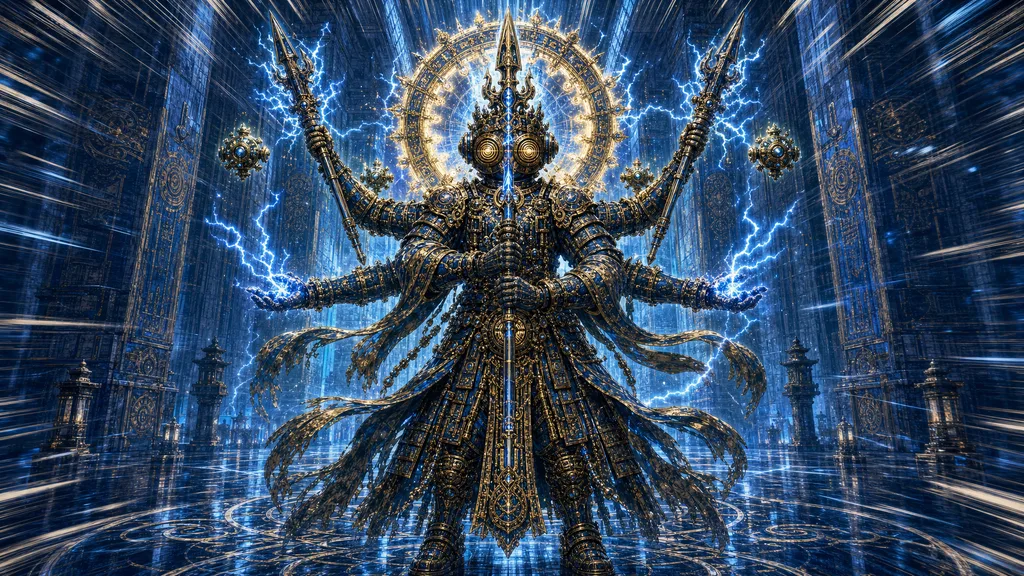
★【2段階の激クラッシュズーム=snap zoom を2段で畳みかける】前カット(遠方・正面のインドラ)から、カメラが【2段階】で一気に詰め寄る一連——第1段で遠景から中景へガッと寄り(石柱の回廊が速度線で後方へ吹き飛ぶ)、第2段でさらに壇上のインドラへ詰めて【上半身〜全身が収まる FS でロック】する。★顔のゴーグルだけに極端に寄り切る BCU では止めない=次カットの墨絵プレートと【同じ『インドラの全身像』の画角】に着地させ、墨絵へ画角を合わせて滑らかに繋ぐ。着地したインドラ: 遮光器の同心円ゴーグル【2眼のみ】(第三/額の目なし)が幾何秩序のオーダー光を放ち、金剛宝冠(ヴァジュラ突起)、背後に金色の太陽光輪+千眼マンダラ後光、【六臂】=中央2手に大ヴァジュラ杖・上左右2手にヴァジュラ稲妻槍・下左右2手から青い電撃、金+藍の多層装甲+流れる金襴ローブ/吹き流し、青い電撃アークが全身から炸裂。2段ズームの放射速度線/モーションブラーが画面四隅から収束して迫力を出すが、最終フレームは『冷たい秩序の神が全身像で屹立する』一枚として読める(墨絵プレートの直接の予兆)。背景の祭壇室は速度線で流れて溶ける。★インドラの目は同心円ゴーグル2眼のみ=第三の目/眼球/顔のディテールを増設しない。★象/アイラーヴァタ/象頭/牙/鼻は描かない。墨ベタ線画+放射速度線、VIVID full-color painted-cel(電撃ブルー/白金主体・放射ブラー)。★象なし。→ 次カット(墨絵 namecard)へさらにクラッシュズームを続け、全身像から【胸上(バスト)】の画角まで一気に寄って reveal する。
Inherit the look of the start and end frames EXACTLY — line weight, ink density, palette, lighting. COPY the look, NOT the framing. Hand-drawn 2D cel anime, 12fps limited-animation look, heavy ink linework. Frame-by-frame — every frame redrawn by hand. NO smooth CG interpolation, NO 3D render, NO tweening, NO motion blur.
★★★ REVEAL NAMECARD FRAME (iconic character introduction · SUMI-E AESTHETIC) ★★★
Character being revealed: ドグー・インドラ / Dogu Indra — Final Form (dogu_indra).
Iconic pose: SOLO CHEST-UP / BUST sumi-e plate of Dogu in INDRA mode (framed from roughly the chest up — the goggle face, vajra treasure-crown, solar halo and upper torso + upper arms FILL the frame; the crash-zoom from the previous cut has pushed in this close; lower body / legs are out of frame), isolated on plain washi / ink-mist negative space. Single shakoki-dogu face with EXACTLY TWO concentric goggle eyes (left + right only, NO third / forehead / central eye) radiating hard geometric order-light; a tall VAJRA treasure-crown (kongo-hokan, upthrust vajra prongs + crystallized lightning) on the head; a brilliant SOLAR HALO + thousand-eye order-mandala ring behind the head; EXACTLY SIX arms (a multi-armed lightning deity) thrown into a DYNAMIC combat stance mid-motion — torso twisted with momentum, the great vajra-staff thrust forward on a bold diagonal, the upper hands raising VAJRA-LIGHTNING LANCES mid-strike, the lower hands hurling brilliant electric arcs; ornate multi-layer armor + flowing brocade robe / war-skirt + tattered streamers all flaring violently with the motion; floating golden vajra-orb satellites flung outward; massive lightning exploding around the whole figure with gestural haboku ink-splash and sweeping speed-strokes — explosive 躍動感 / dynamic energy, NOT a static frontal standing plate. Keep the ornate KV design (NOT a plain stripped look). ABSOLUTELY NO elephant, NO Airavata mount, NO elephant head / trunk / tusks / ears / motif anywhere. NO second character (no Ashura), NO altar hall, NO stone pillars, NO floor crest, NO light-border, NO scene of any kind — only this one Indra-mode Dogu on blank ink-wash ground. MONOCHROME sumi ink (black ink only) + a single small vermilion IVS seal accent in the corner. Vertical brush calligraphy 「ドグー・インドラ」 with the English name below. Strong PUSH-IN, NOT a freeze..
AESTHETIC OVERRIDE (this cut only — this OVERRIDES the cel/full-color style and the style-anchor reference image):
  - DYNAMIC traditional SUMI-E ink-wash painting. Bold one-stroke 一気呵成 brushwork, solid 墨ベタ black masses, violent flung-ink splatter (haboku/tobokuga) and dry-brush kasure edges, deep ink bleeds and drips.
  - ★MONOCHROME BLACK INK ONLY. Render the WHOLE figure in black sumi ink — NO full-color, NO gold/bronze/blue/green fills, NO 'muted earth tones', NO painted-cel color. ★IGNORE the colors of the 1st (style-anchor) reference image and any color in the CHARACTER CANON below — use the references ONLY for the character's form/face/identity, never their color. The ONLY non-ink accents permitted: a tiny vermilion ember in the eyes + one small vermilion 朱印 seal.
  - Aged washi paper background texture, visible paper grain (the paper's natural cream tone is fine; do not add painted color).
  - ★Capture the character in a FIERCE, DYNAMIC pose (combat / intimidation, per the Iconic pose above) with energy bursting outward — NOT a calm static portrait, NOT a faint emerging silhouette. The figure is bold and present, ink exploding around it.
  - Hand-drawn calligraphic line work, NOT computer-clean lines.
  - !! NO SCENE, NO LOCATION, NO ENVIRONMENT BACKGROUND !! Absolutely no streets, neon signs, buildings, crowds, water,
    amusement-park rides, factories or any real-world setting. The character is ISOLATED on a plain aged-washi / ink-wash
    ground ONLY (negative space + ink mist). This is a CHARACTER PORTRAIT PLATE (図鑑の一枚絵), not a scene cut.
    Ignore any CONTEXT.Location / location reference image — the namecard is character-focused, setting-free.
  - !! SOLO — ONLY THIS ONE CHARACTER IN FRAME !! Absolutely NO other characters: no heroes, no other enemies,
    no ghosts/bystanders from the scene description. If the CHARACTER CANON or COMPOSITION below mentions other
    characters, IGNORE them for this plate — they belong to the surrounding cuts, not the namecard.
TEXT IN FRAME (OVERRIDE the no-text rule for this reveal cut ONLY):
  - Render the character's Japanese name 「ドグー・インドラ」 as a VERTICAL classical brush calligraphy on the RIGHT EDGE of the frame.
  - Calligraphic style: bold sumi ink, traditional kaisho or gyousho script, top-to-bottom vertical layout, slight ink bleeds.
  - Below the Japanese name (in much smaller English serif italic): "Dogu Indra — Final Form".
  - Optional small vermilion 朱印 (seal stamp) below the name as authorial signature.
  - DO NOT render any other text, dialogue, subtitle, caption, or kanji elsewhere in the frame.
COMPOSITION:
  - ★TIGHT 寄り FRAMING: a FACE close-up to CHEST-UP BUST of this one character (cropped around the chest) — the head/face and upper body fill the frame, big and close. NOT a full-body plate, NOT a distant wide. The face/mask detail must read sharply.
  - Character centered or slightly off-center (rule-of-thirds), bold dynamic framing (a powerful angle, not flat-frontal).
  - Dramatic backlight (rim light from behind the character).
  - Generous negative space on the right where the calligraphy lives.
MOTION:
  - SLOW BUT CLEARLY NOTICEABLE PUSH-IN toward the character for the full clip — the camera VISIBLY closes in (a real cinematic dolly-in), the figure growing larger in frame and settling on a TIGHTER framing. This is NOT a static freeze; the push-in must read.
  - The character itself holds its pose (no body motion); the energy comes from the steady camera push + the ink / calligraphy forming on.
  - Ambient micro-motion: drifting ink particles, brush-stroke fade-in of the calligraphy, distant mist.
INK-DRAWN REVEAL — the WHOLE image is brushed into existence in one continuous sweep of sumi ink (一気呵成 / drawn in a single breath), NOT faded in and NOT a violent crash-zoom. 3-beat transition for 「ドグー・インドラ」 / Dogu Indra — Final Form:
★ CAMERA: across ALL three beats the camera PUSHES IN steadily toward the character — a slow but CLEARLY NOTICEABLE cinematic dolly-in (NOT a static freeze). The figure grows in frame and the reveal ends on a TIGHT framing.
SHOT 1 (1s) — the previous live scene rapidly DISSOLVES INTO RUNNING BLACK SUMI INK: its forms melt and bleed into wet brush strokes and ink mist; the camera is already pushing in, a single low tone.
HARD CUT TO
SHOT 2 (1s) — ONE CONTINUOUS BRUSH STROKE: fast, confident sumi strokes race across the frame in a single unbroken gesture and re-form into the character — the silhouette, then the full figure, materializing OUT OF the very strokes that draw it, with a 'BUSHAA' ink burst at the peak of the stroke; the camera keeps closing in. The picture is being WRITTEN in ink before your eyes.
HARD CUT TO
SHOT 3 (1-2s) — settle: the last ink particles drift down; the vertical brush-calligraphy name writes on stroke-by-stroke at the right edge in the same continuous hand; a small vermilion seal stamps in. The camera pushes IN to a TIGHT final framing on the finished sumi-e plate (do NOT just freeze wide).
First+Last frame mode: bind the PREVIOUS cut c14-s1-7 as the FIRST frame and THIS sumi-e namecard cut as the LAST frame. Interpolate the ink-drawn reveal between them — the scene must visibly turn INTO ink, the figure + name must visibly be BRUSHED ON in one sweep, and the CAMERA must clearly PUSH IN toward the character (ending tight, not a static wide).
Audio: silence → a single wet ink-brush sweep / ink-burst impact → low resonant tone. No music, no dialogue (no spoken voice; dialogue added in the edit).
Negative prompt: photorealistic, 3D render, CGI, Pixar style, smooth tweening, computer interpolation, AI inbetweening, speech bubble, dialogue balloon, subtitle, text overlay, cute, kawaii, chibi, identity drift, face wobble, character morphing, watermark, logo, blurry, low quality
コピー後、Kling V3 または Seedance 2.0 の prompt 欄にペースト。start frame に cut 画像。
両者が構える全景。六腕が広がり、金剛杵が構えられる。光の境界線が明確になり、宿命的な戦いの開始であると同時に、二人の本音が出る唯一の場が立ち上がる。
FIX のワイドで構えの完成形を一望させ、戦いそのものを「対話の代替手段」として観客に承認させる。
戦うことが話すことになる瞬間を構図の対称性で宣言し、第二幕への確かな扉を開ける。
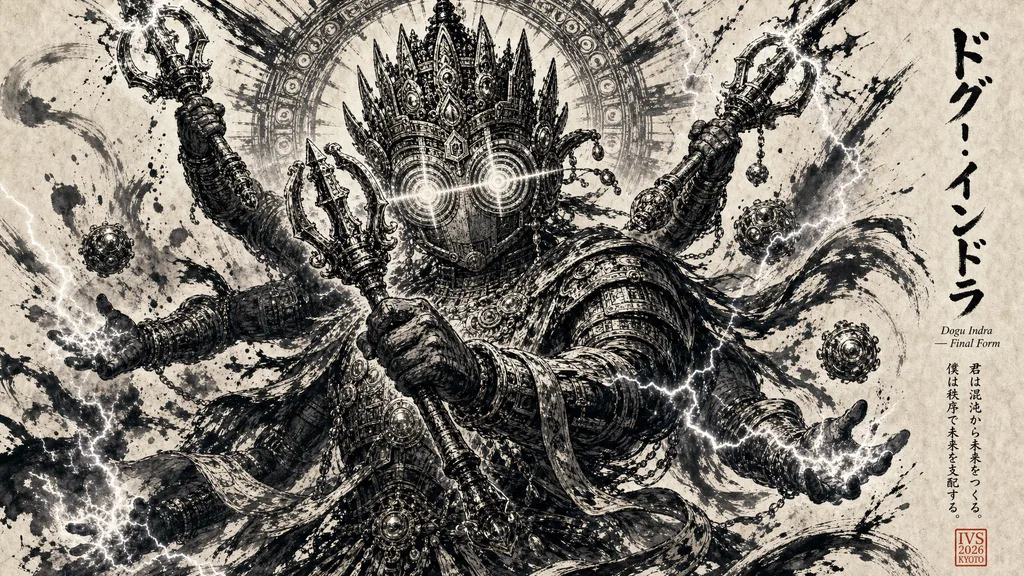
ドグー・インドラ単体のリビール墨絵プレート(図鑑の一枚絵・sumi-e)。★前カットのクラッシュズームを継続して【胸上(バスト)】まで寄り切った構図——インドラへ変容したドグーの【胸から上(遮光器の同心円ゴーグルの顔・金剛宝冠・背後の太陽光輪+千眼マンダラ・上半身と上の腕)】が画面いっぱいを占め、下半身/脚はフレーム外。墨ベタの霧と washi の余白の中で【躍動感のある動的なポーズ】を取る——上体を捻って勢いをつけ、上の腕の稲妻槍を振りかぶり、もう一対の手から電撃を放ち、吹き流しと金襴ローブと電撃が motion で激しく流れ、潑墨(haboku)の墨飛沫と速度筆が顔のまわりから外へ爆ぜる(★静的な正面立ちプレートにしない=寄りの胸上+躍動感を最優先)。遮光器の同心円ゴーグル【2眼のみ】(第三/額の目なし)が幾何秩序のオーダー光を放ち、金剛宝冠(ヴァジュラ突起と結晶化した雷の冠)と金色の太陽光輪+千眼マンダラ後光、【六臂】=中央2手に大ヴァジュラ杖・上左右2手にヴァジュラ稲妻槍・下左右2手から青い電撃、金+藍の多層装甲+流れる金襴ローブ/吹き流し、周囲に金色ヴァジュラ宝珠クラスタが浮遊し全身に強烈な電撃。★ソロ厳守——阿修羅(味方)・他キャラ・冷青の祭壇室の情景・石柱・床の神紋・光の境界線は【一切描かない】。背景は無地の washi / 墨ぼかしのみ(間・石柱・空・都市を出さない)。★象/アイラーヴァタ/象頭/牙/鼻/象の上の玉座は画面のどこにも描かない=Dogu インドラ本人のみ。右端に縦書き墨書きカリグラフィ『ドグー・インドラ』、その下に小さく英字『Dogu Indra — Final Form』、脇に tagline『君は混沌から未来をつくる。僕は秩序で未来を支配する。』。墨黒主体(モノクロ墨絵)、隅に小さく vermilion の IVS 朱印を一つだけアクセント(身体に朱/色は乗せない)。シーン cut ではなくキャラ紹介プレート。カメラは明確に push-in(FREEZE/微速にしない)。★象なし。
Inherit the look of the start and end frames EXACTLY — line weight, ink density, palette, lighting. COPY the look, NOT the framing. Hand-drawn 2D cel anime, 12fps limited-animation look, heavy ink linework. Frame-by-frame — every frame redrawn by hand. NO smooth CG interpolation, NO 3D render, NO tweening, NO motion blur.
★★★ REVEAL NAMECARD FRAME (iconic character introduction · SUMI-E AESTHETIC) ★★★
Character being revealed: ドグー・インドラ / Dogu Indra — Final Form (dogu_indra).
Iconic pose: SOLO CHEST-UP / BUST sumi-e plate of Dogu in INDRA mode (framed from roughly the chest up — the goggle face, vajra treasure-crown, solar halo and upper torso + upper arms FILL the frame; the crash-zoom from the previous cut has pushed in this close; lower body / legs are out of frame), isolated on plain washi / ink-mist negative space. Single shakoki-dogu face with EXACTLY TWO concentric goggle eyes (left + right only, NO third / forehead / central eye) radiating hard geometric order-light; a tall VAJRA treasure-crown (kongo-hokan, upthrust vajra prongs + crystallized lightning) on the head; a brilliant SOLAR HALO + thousand-eye order-mandala ring behind the head; EXACTLY SIX arms (a multi-armed lightning deity) thrown into a DYNAMIC combat stance mid-motion — torso twisted with momentum, the great vajra-staff thrust forward on a bold diagonal, the upper hands raising VAJRA-LIGHTNING LANCES mid-strike, the lower hands hurling brilliant electric arcs; ornate multi-layer armor + flowing brocade robe / war-skirt + tattered streamers all flaring violently with the motion; floating golden vajra-orb satellites flung outward; massive lightning exploding around the whole figure with gestural haboku ink-splash and sweeping speed-strokes — explosive 躍動感 / dynamic energy, NOT a static frontal standing plate. Keep the ornate KV design (NOT a plain stripped look). ABSOLUTELY NO elephant, NO Airavata mount, NO elephant head / trunk / tusks / ears / motif anywhere. NO second character (no Ashura), NO altar hall, NO stone pillars, NO floor crest, NO light-border, NO scene of any kind — only this one Indra-mode Dogu on blank ink-wash ground. MONOCHROME sumi ink (black ink only) + a single small vermilion IVS seal accent in the corner. Vertical brush calligraphy 「ドグー・インドラ」 with the English name below. Strong PUSH-IN, NOT a freeze..
AESTHETIC OVERRIDE (this cut only — this OVERRIDES the cel/full-color style and the style-anchor reference image):
  - DYNAMIC traditional SUMI-E ink-wash painting. Bold one-stroke 一気呵成 brushwork, solid 墨ベタ black masses, violent flung-ink splatter (haboku/tobokuga) and dry-brush kasure edges, deep ink bleeds and drips.
  - ★MONOCHROME BLACK INK ONLY. Render the WHOLE figure in black sumi ink — NO full-color, NO gold/bronze/blue/green fills, NO 'muted earth tones', NO painted-cel color. ★IGNORE the colors of the 1st (style-anchor) reference image and any color in the CHARACTER CANON below — use the references ONLY for the character's form/face/identity, never their color. The ONLY non-ink accents permitted: a tiny vermilion ember in the eyes + one small vermilion 朱印 seal.
  - Aged washi paper background texture, visible paper grain (the paper's natural cream tone is fine; do not add painted color).
  - ★Capture the character in a FIERCE, DYNAMIC pose (combat / intimidation, per the Iconic pose above) with energy bursting outward — NOT a calm static portrait, NOT a faint emerging silhouette. The figure is bold and present, ink exploding around it.
  - Hand-drawn calligraphic line work, NOT computer-clean lines.
  - !! NO SCENE, NO LOCATION, NO ENVIRONMENT BACKGROUND !! Absolutely no streets, neon signs, buildings, crowds, water,
    amusement-park rides, factories or any real-world setting. The character is ISOLATED on a plain aged-washi / ink-wash
    ground ONLY (negative space + ink mist). This is a CHARACTER PORTRAIT PLATE (図鑑の一枚絵), not a scene cut.
    Ignore any CONTEXT.Location / location reference image — the namecard is character-focused, setting-free.
  - !! SOLO — ONLY THIS ONE CHARACTER IN FRAME !! Absolutely NO other characters: no heroes, no other enemies,
    no ghosts/bystanders from the scene description. If the CHARACTER CANON or COMPOSITION below mentions other
    characters, IGNORE them for this plate — they belong to the surrounding cuts, not the namecard.
TEXT IN FRAME (OVERRIDE the no-text rule for this reveal cut ONLY):
  - Render the character's Japanese name 「ドグー・インドラ」 as a VERTICAL classical brush calligraphy on the RIGHT EDGE of the frame.
  - Calligraphic style: bold sumi ink, traditional kaisho or gyousho script, top-to-bottom vertical layout, slight ink bleeds.
  - Below the Japanese name (in much smaller English serif italic): "Dogu Indra — Final Form".
  - Optional small vermilion 朱印 (seal stamp) below the name as authorial signature.
  - DO NOT render any other text, dialogue, subtitle, caption, or kanji elsewhere in the frame.
COMPOSITION:
  - ★TIGHT 寄り FRAMING: a FACE close-up to CHEST-UP BUST of this one character (cropped around the chest) — the head/face and upper body fill the frame, big and close. NOT a full-body plate, NOT a distant wide. The face/mask detail must read sharply.
  - Character centered or slightly off-center (rule-of-thirds), bold dynamic framing (a powerful angle, not flat-frontal).
  - Dramatic backlight (rim light from behind the character).
  - Generous negative space on the right where the calligraphy lives.
MOTION:
  - SLOW BUT CLEARLY NOTICEABLE PUSH-IN toward the character for the full clip — the camera VISIBLY closes in (a real cinematic dolly-in), the figure growing larger in frame and settling on a TIGHTER framing. This is NOT a static freeze; the push-in must read.
  - The character itself holds its pose (no body motion); the energy comes from the steady camera push + the ink / calligraphy forming on.
  - Ambient micro-motion: drifting ink particles, brush-stroke fade-in of the calligraphy, distant mist.
INK-DRAWN REVEAL — the WHOLE image is brushed into existence in one continuous sweep of sumi ink (一気呵成 / drawn in a single breath), NOT faded in and NOT a violent crash-zoom. 3-beat transition for 「ドグー・インドラ」 / Dogu Indra — Final Form:
★ CAMERA: across ALL three beats the camera PUSHES IN steadily toward the character — a slow but CLEARLY NOTICEABLE cinematic dolly-in (NOT a static freeze). The figure grows in frame and the reveal ends on a TIGHT framing.
SHOT 1 (1s) — the previous live scene rapidly DISSOLVES INTO RUNNING BLACK SUMI INK: its forms melt and bleed into wet brush strokes and ink mist; the camera is already pushing in, a single low tone.
HARD CUT TO
SHOT 2 (1s) — ONE CONTINUOUS BRUSH STROKE: fast, confident sumi strokes race across the frame in a single unbroken gesture and re-form into the character — the silhouette, then the full figure, materializing OUT OF the very strokes that draw it, with a 'BUSHAA' ink burst at the peak of the stroke; the camera keeps closing in. The picture is being WRITTEN in ink before your eyes.
HARD CUT TO
SHOT 3 (1-2s) — settle: the last ink particles drift down; the vertical brush-calligraphy name writes on stroke-by-stroke at the right edge in the same continuous hand; a small vermilion seal stamps in. The camera pushes IN to a TIGHT final framing on the finished sumi-e plate (do NOT just freeze wide).
First+Last frame mode: bind the PREVIOUS cut (or the scene-transition's from-cut when this reveal opens a scene) as the FIRST frame and THIS sumi-e namecard cut as the LAST frame. Interpolate the ink-drawn reveal between them — the scene must visibly turn INTO ink, the figure + name must visibly be BRUSHED ON in one sweep, and the CAMERA must clearly PUSH IN toward the character (ending tight, not a static wide).
Audio: silence → a single wet ink-brush sweep / ink-burst impact → low resonant tone. No music, no dialogue (no spoken voice; dialogue added in the edit).
Negative prompt: photorealistic, 3D render, CGI, Pixar style, smooth tweening, computer interpolation, AI inbetweening, speech bubble, dialogue balloon, subtitle, text overlay, cute, kawaii, chibi, identity drift, face wobble, character morphing, watermark, logo, blurry, low quality
リビール:first frame に直前 cut(シーン冒頭リビールはシーン転換の from cut)→ last frame にこの墨絵 namecard(ink-splash 3-shot)。シーン冒頭の転換はシーン見出しの Transition パネルからコピー。
床の光の境界線の超クロースアップ。朱と白金が接触する一本の線——線が揺れる。「境界」は安定でなく動的で、どちらが侵食するかはまだ分からない。
ECU で線そのものを主役にすることで、章全体の「問い」を物理的な一本の揺らぎに凝縮する。
勝敗ではなく境界の不安定さを核に据え、後に来る衝突の意味を予告する。
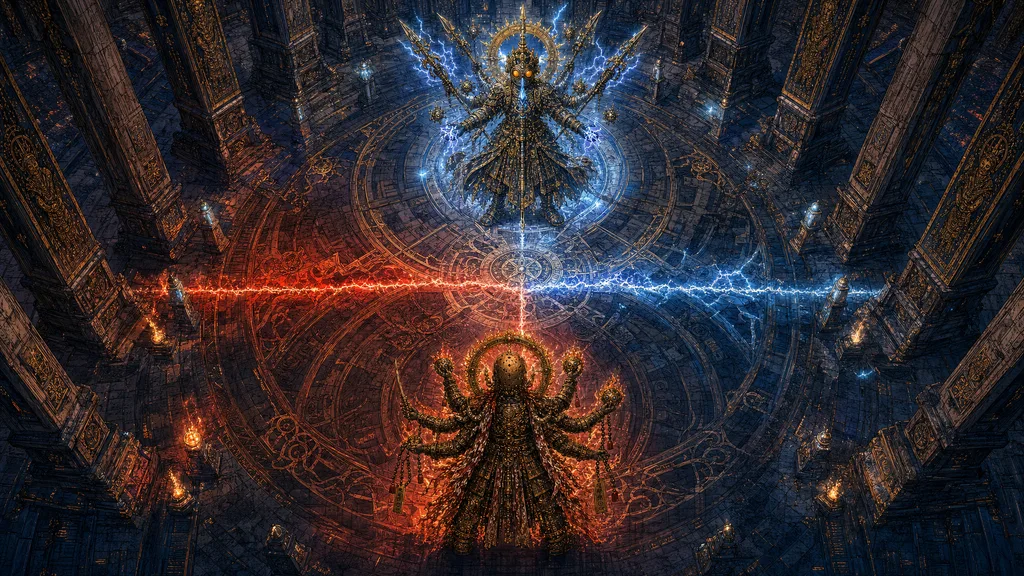
★【真上からの俯瞰=BEV(bird's-eye / 真俯瞰)】祭壇室の対峙を【真上から見下ろす】超ロング ELS——世界観衝突の地図を一枚で読ませる establishing。冷青の祭壇室の全景を真俯瞰で捉え、整然と並ぶ幾何学石柱が左右対称の格子をなし、床の大きな曼荼羅状の神紋が円として見下ろされる。手前側(画面下)に踏み入ったばかりの阿修羅が小さく(六腕・火炎冠・★真俯瞰のため頭頂の素焼きドーム上面=無孔の滑らかな曲面が見える・前面の顔/眼穴は真上からは見えない)、遥か対岸(画面上)の壇上にインドラの白金/電撃ブルーの秩序光が円く溜まる。床の中央を、冷(藍青・電撃ブルー)と暖(朱)が接触する一本の光の境界線が一直線に横切り、阿修羅とインドラを地図上の二点として分断する。真上視点が『対立の構図』を幾何学的な地図として提示する。屋外の空/都市は出さない(宮殿内に閉じる)。★阿修羅=公式KV単一面・六臂・剣/刀なし・★頭の左右のドローン/雪片状フラクタル装飾は描かない=廃止。★象/アイラーヴァタ/象頭/牙/鼻は描かない。墨ベタ線画+crosshatch、VIVID full-color painted-cel(冷青+金+藍に、阿修羅の朱を一点)。★象なし。
Kling 3.0 Omni (Multi-Shot) を ON にして、first frame に このカット(c14-s1-9)・last frame に 次カット(c14-s1-10) を Bind → 下の 3 枠を Shot 1〜3 に各々ペースト。HARD CUT で繋ぐ ~4s。
Camera lifts off from eye-level behind Ashura; the hall begins to open out below.
Crane rises rapidly; vermilion and platinum auras bloom into two circles dividing the floor. STRONG MOTION: at the moment of contact a ring shockwave detonates from the impact point, blasting the cloud-sea, smoke and debris violently OUTWARD in all directions; dust rings expand, banners and dust streak away from the blast. Big, decisive displacement — never a small jiggle.
Top-down hold: two perfect circles of light split the altar room into halves.
速いクレーンアップ。祭壇室全体が見渡せる高さから、阿修羅と対峙するインドラの俯瞰。二つの光が円形に広がり、部屋全体を二分する。
EYE から BIRD へのクレーンで対立図を宇宙のスケールに引き上げ、神域での衝突を地理として理解させる。
個の対峙を世界規模の構図へ昇華し、章の重力を増す。
対峙が定まった刹那、インドラが静かに一度頷く CU——言葉ではなく所作で『戦い』を肯定する。金剛宝冠の影の下、同心円ゴーグル【2眼のみ】が一度だけ強く幾何光を絞り、六臂のヴァジュラ稲妻槍と大ヴァジュラ杖が同時に青い電撃で一閃する(開戦の所作)。無言の頷きが最も重い『応』を運ぶ——認めることで真の対決が成立する。★インドラ=六臂の電撃神(同心円ゴーグル2眼・金+藍・★象は描かない)。★インドラは相手=阿修羅の方を向く向き。墨ベタ+金青/電撃ブルーの閃光、VIVID full-color painted-cel。★象なし。
Kling 3.0 Omni (Multi-Shot) を ON にして、first frame に このカット(c14-s1-10)・last frame に 次カット(c14-s1-11) を Bind → 下の 3 枠を Shot 1〜3 に各々ペースト。HARD CUT で繋ぐ ~5s。
Both fighters step in together; six arms and vajra converge toward a single point above the seam.
Impact ignites: vermilion and platinum collide, light boils outward filling the columns. STRONG MOTION: at the moment of contact a ring shockwave detonates from the impact point, blasting the cloud-sea, smoke and debris violently OUTWARD in all directions; dust rings expand, banners and dust streak away from the blast. Big, decisive displacement — never a small jiggle.
Frame blows out to pure white as the boundary line detonates.
両者が同時に踏み込む瞬間の全景。六腕と金剛杵が一点に向かって収束する。光の境界線が爆発し、フレームを白に塗りつぶす——白飛びが次章へのカットの橋になる。
FIX のワイドで二者の同期した動きを完全対称に捉え、衝突を一点収束の幾何として記録する。
ホワイトアウトを次章への省略記法として用い、衝突の細部を観客の想像に委ねる。
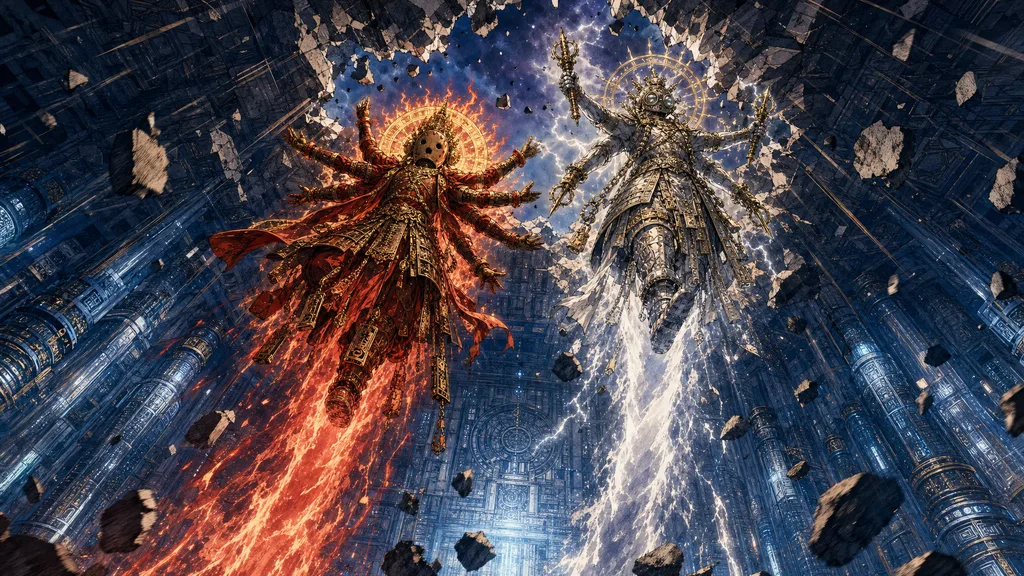
対峙を破った瞬間、両者が祭壇室の天蓋を突き破って雲上へ駆け上がる垂直上昇のブリッジ LS(室内→空中の接続を動機づける)。画面下、阿修羅(朱・六腕)とインドラ(金+藍・六臂の電撃神・青い電撃をまとい雷雲を足場に)が朱(火)と藍青(電撃ブルー)の二条の光跡を引いて同時に上昇し、頭上の高い天蓋の石が砕け、青白光の間から外の薄い indigo-blue の空が裂け目から覗く。砕けた天蓋の石片が二人を追って巻き上がる。冷青の閉じた神域から雲上の開けた高高度へ——次シーン sc02 空中戦の from フレーム。★両者は上方(脱出方向)と互いを意識する向き。★インドラに象は描かない(上昇の足場は自ら呼んだ雷雲)。墨ベタ+朱と藍青/電撃ブルーの光跡+速度線、VIVID full-color painted-cel。→ sc02 空中戦へ(高エネルギー転換 smash-cut/whip 推奨)。★象なし。
Kling Custom Multi-Shot を ON にして、上の AFTER カット画像 1 枚 を Bind Elements にアップロード → 下の 2 枠を Shot 1〜2 に各々ペースト → Duration を表示通りに設定。
From pure white, darkness floods back; only the vermilion hip seal glows, beating.
Seal pulses twice, stronger; clay surface around it slowly resolves into focus.
白飛びの後、最初に現れるのは腰の朱印——脈打ち、赤く燃えている。朱印が「存在の証明」として最も早く暗闇から現れる——体より先に「意志」が戻ってくる。
ECU で朱印だけを暗闇に浮かばせ、感覚の復帰順序を「意志→身体」として観客に体感させる。
戦闘の余韻と再起の予感を、最小のイメージ(脈打つ朱印)に圧縮する。